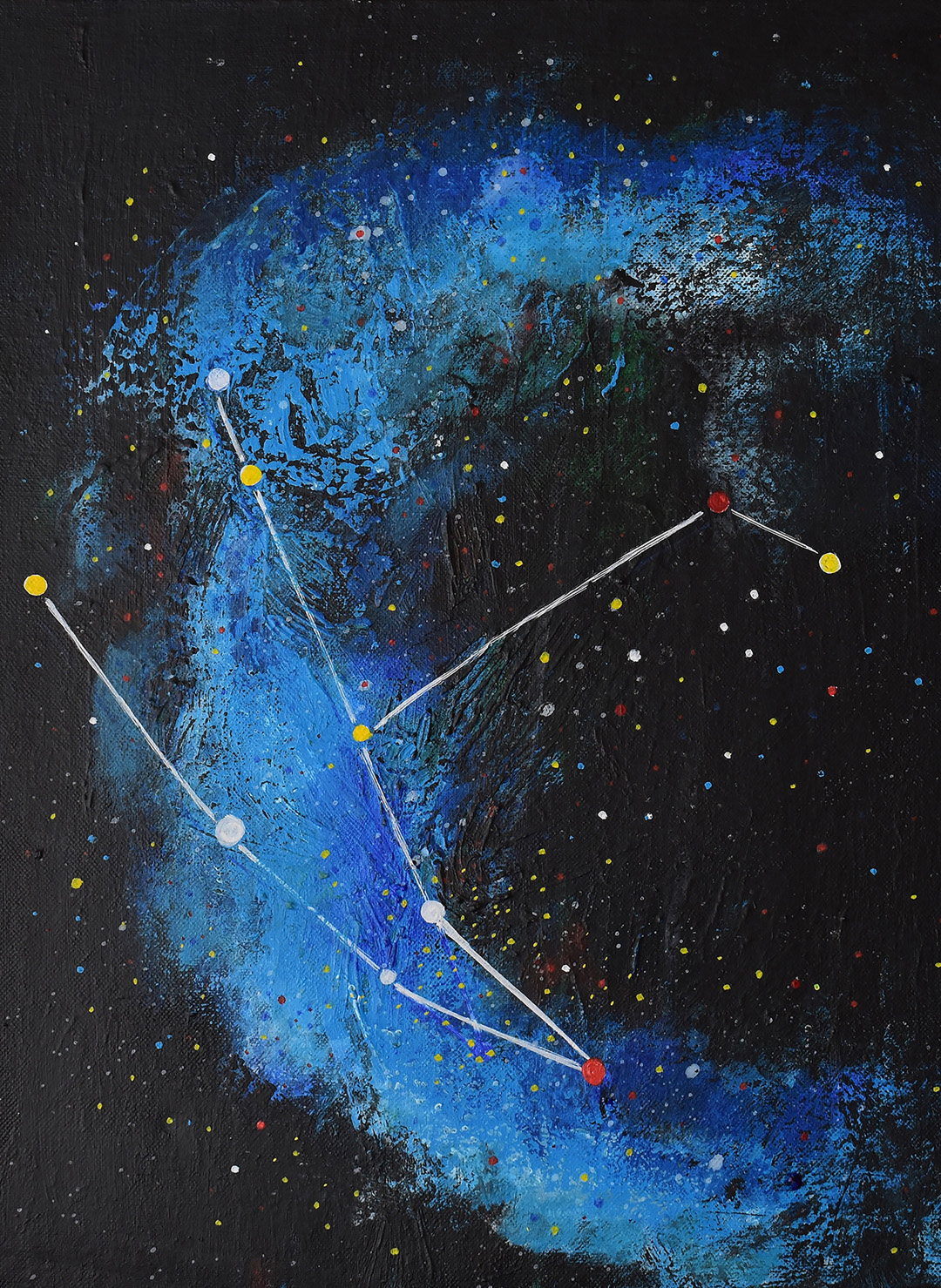


Our collective imaginations once connected the bright lights of the night sky in patterns meaningful to them: gods, heroes, and animals. Their lives are entwined with mythologies, and each culture since prehistory used these patterns to make sense of their lives in this vast universe. Modern astronomy now identifies eighty-eight constellations that mapped the celestial sphere with their continuous boundaries and, with the calculus of a celestial coordinate system, can specify the position of any celestial object within these constellations. Now we also know that from Earth, each of those objects is so far away that we need to use the speed of light to measure the distance, and every ingredient in our body is made from the elements forged by stars; we are made of star stuff, as Carl Sagan once famously said or Rumi more poetically, we are stars wrapped in skin.
But without knowing these facts, I fell in love with the mesmerising beauty of the night sky very early in my life. It appealed to me in aesthetics and its power to remind us of our insignificant yet infinitely precious life. We all inherited this love and connection to the sky, later reinforced by rhymes, folklore and mythical stories through countless generations. I remember those nights watching the sky in rural Bangladesh away from the pollution of city lights, the fantastic feeling of discovering the patterns and recognising the constellations with all their culture-specific nomenclatures. I used to gaze at the stars hour after hour and learn the shapes and names of the constellation as many as I could.
I read the stories about them, the Orion, the hunter who lost his vision for love and later angered the earth goddess Gaia with his arrogance, or the insensitive Cassiopeia who decided to sacrifice her daughter Andromeda to appease a god or the impossible fate of Perseus who later saved princess Andromeda or the great bear, known since prehistory, named after seven sages by the ancient Indian astronomers, once guided the ancient mariners to find pole star before the age of compass, and how the seven sad daughters of Atlas immortalised as the Pleiades and many more. With all their complexity, these mythical stories of human lives opened a window for me. I could relate to those stories of love, hate, abandonment, betrayals, despair, the wrath of gods, and the indomitable human spirit that is resilient with everlasting hope by seeing fragments of myself in them.
Another surprising fact reminded us that the imaginary lines create patterns of connected stars located light years away from each other and in different planes and how they change their shapes over many thousands of years. But from the perspective of the earth, they seem close to each other like chalk lines connecting the dots on an immense blackboard. If we could shift our perspective and look at the earth from somewhere distant, like Voyager did at the end of last century, our planet would be just a speck of dust in the vast expanse of space, the pale blue dot. However, here on this planet, we are oblivious to our cosmic insignificance and pride ourselves in our self-importance. Instead of connecting, we are all moving further apart from each other and nature.
So often in our personal lives, we felt displaced and disconnected. At birth, we separated ourselves from the womb with a promise of life, and we made connections as we went through our lives. A life soon to be enriched by the myriads of relationships. We disconnect ourselves from our homeland and connect ourselves with a different land; in this process of connection and disconnection, we live our lives. It is as if we are carrying a set of constellations within us, and we can imagine and re-imagine the lines and create a pattern of relationships in our internal sphere, locating anything in this perceived universe through a coordinate system built in our mind. Looking at the sky also reminds us of what Sagan once said: our responsibility is to be kind to each other and preserve and cherish our pale blue dot, the only home we’ve ever known.